 +1 (248) 723-7903
+1 (248) 723-7903
+1 (248) 723-7903
We’re witnessing a peculiar moment in business technology history. CEOs are simultaneously terrified of falling behind in AI adoption and paralyzed by the complexity of implementation.
The market response has been predictable: a flood of AI SaaS solutions promising instant transformation with zero technical lift. Subscribe, integrate, transform—it sounds almost too good to be true.
It is.
The uncomfortable reality is that most AI SaaS companies are sophisticated wrappers around the same underlying technologies—OpenAI APIs, vector databases, and orchestration code—that any competent development team can access directly. More troubling still, as venture funding tightens and the AI landscape consolidates, many of today’s AI vendors face existential threats to their survival. When a startup shuts down or pivots, your critical business processes go dark with them.
But the deepest risk isn’t operational disruption—it’s strategic surrender. When you pipe your proprietary business context through external AI platforms, you’re outsourcing your competitive differentiation to vendors who may not exist in eighteen months. You’re training their models on your data. You’re embedding your workflows in their architecture. You’re converting what should be permanent strategic assets into recurring operational expenses that drag down EBITDA.
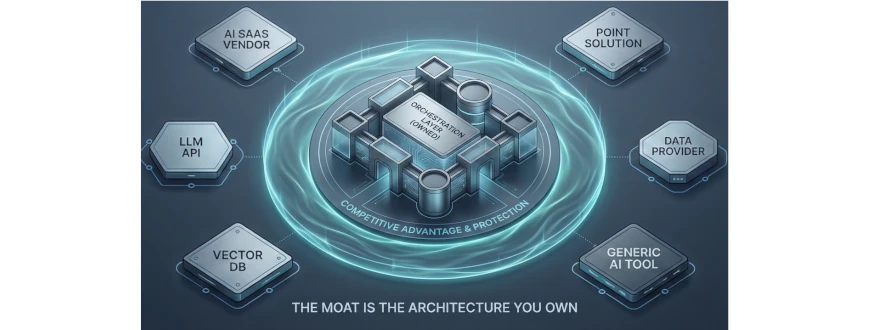
The alternative isn’t a simplistic “build everything” approach—that’s equally naive. The winning strategy is architectural discipline: own your orchestration layer while selectively integrating best-of-breed point solutions through well-defined, replaceable interfaces. Think of it as owning the nervous system of your AI capabilities while treating individual AI models and specialized tools as interchangeable organs. When one fails or becomes obsolete, you swap it out without reconstructing the entire body.
This isn’t theoretical architecture—it’s pragmatic business strategy backed by financial logic, competitive positioning, and risk mitigation. Let me show you why the companies that will dominate their markets five years from now are the ones building AI infrastructure they own, not rent.
Identify bottlenecks, automate workflows, and build fast.
Get Started TodayThe data tells a sobering story. In 2024, 966 startups shut down compared to 769 in 2023—a 25.6% increase. Enterprise SaaS companies took the biggest hit, accounting for 32% of those shutdowns. Traditional SaaS businesses are being systematically shut out of venture funding as AI-native startups dominate the landscape.
Here’s the uncomfortable truth that should keep every CTO and CFO awake at night: when your critical business processes depend on an AI vendor’s survival, you’ve outsourced your competitive advantage to their cap table. Your invoice processing, customer communication, pricing optimization, or document workflows are now hostage to whether their Series C round closes, whether their burn rate proves sustainable, or whether a larger competitor acquires and sunsets them.
The risk isn’t abstract. It’s happening now, accelerating, and companies with deep vendor dependencies are learning painful lessons about the difference between technology adoption and strategic vulnerability.
We need to acknowledge what most AI SaaS companies actually are—elegant interfaces wrapping readily available core technologies. They package OpenAI or Anthropic APIs, vector databases like Pinecone or Azure AI Search, and orchestration code into user-friendly experiences. As Google India Accelerator recently warned, these “thin AI layers” face three existential challenges that should terrify anyone betting their business on them.
First, lack of defensibility: Any feature an AI wrapper builds can be replicated overnight by competitors with access to the same underlying models and databases. There’s no moat when your entire product is an API call away from commoditization.
Second, API dependency risk: Changes in foundation model pricing, access policies, or capabilities can destroy business models instantly. When OpenAI adjusts pricing or deprecates an API version, wrapper companies scramble to maintain margins or rewrite entire platforms. Your business gets caught in the turbulence.
Third, limited value capture: Most economic value flows to the base model providers—OpenAI, Anthropic, Google—leaving wrappers competing on razor-thin margins. This creates a death spiral: they must raise prices to survive, but customers increasingly realize they can access the same underlying technology directly for a fraction of the cost.
The question we should be asking isn’t whether these tools work today—many do, and impressively so. The question is: will they exist tomorrow, and what happens to your business when they don’t? More importantly, why pay premium subscription fees for commoditized access to technology you could own outright?
Let’s address the elephant in the boardroom that nobody wants to confront directly. When you pipe your proprietary business context—customer interactions, pricing strategies, operational workflows, competitive intelligence—through an AI SaaS platform, you’re providing the training ground for their next competitive feature. In some cases, you’re enabling them to build aggregated insights they can sell to your competitors.
Read the terms of service carefully. Many AI SaaS providers explicitly reserve rights to use your data to “improve their services.” That’s corporate speak for training their models on your competitive differentiation. Even when providers claim data isolation, the reality is that your business logic, your process optimizations, your hard-won operational insights are being fed into systems you don’t control.
Orchestrating AI and providing business context is your unique competitive advantage. It’s the secret sauce that makes your company different from competitors using the same products, serving similar markets, competing for the same customers. Why would you let an external vendor train their models on the very information that differentiates you in the market? Why would you teach a third party the nuances of your business so they can package that learning and sell it to everyone else?
The answer, of course, is that you shouldn’t. Strategic differentiation belongs inside your walls, not in a vendor’s training pipeline.
The traditional “build versus buy” debate misses the point entirely when it comes to AI. It forces a false choice between expensive, slow custom development and risky vendor dependency. Both extremes are strategic errors.
The winning model is hybrid: own your orchestration layer while selectively integrating best-of-breed point solutions where they add genuine value. Think of it as the bulkhead pattern in software architecture applied to AI strategy.
Your orchestration layer—the nerve center that coordinates AI models, manages data flows, allocates resources, enforces business rules, and ensures compliance—must be yours. This layer creates several critical strategic advantages.
Interface segregation: Each AI SaaS integration has a well-characterized, well-documented interface. The rest of your system doesn’t know or care what’s behind that interface—it could be an external API, an internal model, or a human process. This abstraction protects you.
Plug-and-play replacement: When a vendor shuts down, pivots, price-gouges, or simply fails to keep pace with better alternatives, you swap them out without rewriting your entire system. The replacement effort is measured in days or weeks, not months or quarters.
Risk mitigation: Your business continuity doesn’t depend on any single vendor’s survival, pricing stability, or strategic direction. You’ve architected resilience into your core operations.
Competitive differentiation: The orchestration logic—how you route decisions, validate outputs, combine multiple AI capabilities, enforce quality gates, and integrate with your unique processes—becomes your proprietary IP. This is what competitors can’t replicate, regardless of which underlying models they use.
The discipline is simple but powerful: for any AI capability, own the harness it plugs into. The AI model itself might be commoditized—and increasingly will be—but the way you orchestrate, validate, and integrate it into your specific business context is defensible competitive advantage.
At Proactive Technology Management, we’ve architected dozens of AI solutions for SMBs and PE-backed portfolio companies using what we call the Fusion Development framework. It harmonizes three layers into a coherent, scalable system that businesses own completely.
Data Foundation: A unified, governed data warehouse—your single source of truth—that feeds clean, contextualized information to AI systems. Without this foundation, AI becomes garbage-in-garbage-out at enterprise scale. This layer includes data quality pipelines, transformation logic, semantic modeling, and access governance. It’s not glamorous, but it’s essential.
Intelligent Orchestration: Deterministic workflow engines that coordinate AI agents, RPA bots, and human decision points into end-to-end business processes. You define the stations, the sequence, the routing rules, the validation checkpoints, and the escalation paths. The system executes reliably, logs comprehensively, and adapts systematically. This is where your business logic lives—where generic AI capabilities become your specific competitive advantage.
AI Reasoning: Strategic deployment of large language models and specialized AI capabilities at specific workstations—document extraction, intelligent classification, content generation, anomaly detection—where they add measurable value. Each AI component has clear inputs, defined outputs, and quality metrics. They’re powerful tools, not magic boxes.
The key insight that separates this approach from both “buy everything” and “build everything” extremes: the orchestration is deterministic and yours. The AI components are modular and replaceable. When GPT-6 or Claude Opus 5 launches with better reasoning or lower costs, you swap in the new model without rewriting your business logic. When a better document extraction service becomes available, you redirect your orchestration to use it. The business process remains stable even as the underlying technology evolves.
This architectural separation creates resilience, agility, and genuine competitive advantage in ways that monolithic SaaS solutions or haphazard point tool adoption never can.
Consider our approach to Intelligent Document Processing—a domain where many companies buy end-to-end IDP SaaS solutions and accept whatever accuracy the vendor provides. Industry standard is typically 85-92% out of the box, with hallucinations, misclassifications, and extraction errors baked in as acceptable collateral damage. For high-stakes documents like contracts, invoices, or compliance filings, that error rate is unacceptable.
Our approach builds a custom maker-checker architecture where Azure Document Intelligence performs the initial extraction, a specialized large language model validates and enriches the results against business rules, and a human-in-the-loop reviews exceptions. The orchestration layer tracks every decision, logs every correction, captures every human override, and uses that feedback to continuously improve accuracy.
The result: 95%+ accuracy with a clear audit trail, comprehensive exception handling, and continuous learning. More importantly, the entire system runs in your Azure tenant. When Azure releases Document Intelligence v4.0 with improved extraction capabilities, you get the upgrade automatically without vendor negotiations or migration projects. When a better validation LLM becomes available—whether from OpenAI, Anthropic, or an open-source alternative—you plug it in through your orchestration layer. The business process doesn’t change. The accuracy improves. The cost potentially decreases.
This is what architectural discipline enables: continuous improvement without platform risk, optimization without vendor dependency, and competitive advantage that compounds over time rather than eroding as technology commoditizes.
To be absolutely clear: we’re not advocating for “build everything from scratch” fundamentalism. That’s as strategically foolish as “buy everything as SaaS” dependency. There are excellent vertical-specific AI SaaS tools for niche processes—industry-specific compliance checking, specialized data enrichment, domain-specific analytics, or regulated workflow automation.
The discipline is this: for any AI SaaS you integrate, own the harness it plugs into. Your orchestration layer should perform four critical functions that protect your business and preserve your strategic optionality.
First, abstract the interface: The rest of your system doesn’t directly call the vendor’s API. It calls your orchestration layer, which routes to the vendor. This abstraction means changing vendors requires updating one integration point, not hunting through your entire codebase for embedded API calls.
Second, validate outputs: Don’t blindly trust AI SaaS results. Your orchestration layer enforces business rules, applies quality gates, checks for hallucinations, and validates against known constraints before accepting results. The AI SaaS provides suggestions; your system makes decisions.
Third, log everything: Create complete observability of what the AI SaaS does, enabling compliance audit trails, debugging when things go wrong, performance tracking over time, and cost attribution. You should know exactly what value the vendor provides and what it costs, measured not just in subscription fees but in accuracy, latency, and business outcomes.
Fourth, enable replacement: Document exactly what the AI SaaS provides—its inputs, outputs, accuracy characteristics, latency profiles, and cost structure—so you can swap in an alternative or build your own implementation if needed. This isn’t paranoia; it’s architectural discipline that prevents vendor lock-in from becoming strategic paralysis.
This architectural approach turns risky vendor dependencies into managed, replaceable components. You get the benefits of specialized tools without the strategic vulnerability of irreplaceable dependencies.
When we architect AI solutions for clients, everything runs in their Azure subscription. They own 100% of the code, the data pipelines, the custom agents, and the comprehensive documentation. There’s no vendor lock-in, no surprise pricing changes, no dependency on a startup’s Series C round closing. More importantly, there’s a tangible asset that increases enterprise value rather than an operating expense that decreases it.
For PE-backed companies especially, this matters profoundly. An AI capability built as owned infrastructure contributes to exit valuation. An AI capability rented through SaaS subscriptions is a liability the acquirer assumes. The difference in enterprise value is measurable and significant.
If you’re evaluating AI investments—whether you’re a CFO, COO, CTO, or business unit leader—here’s the strategic framework that separates sustainable competitive advantage from expensive vendor dependency.
For core workflows that define your business: Quote-to-cash, renewals, collections, underwriting, pricing, customer onboardingWhen you join us as a new client, we take all the necessary ..., or any process that directly impacts revenue or competitive differentiation—own the orchestration layer. Build it as a strategic asset. Use best-of-breed AI models as interchangeable components, but own the logic that coordinates them, validates their outputs, and integrates them into your specific business context.
For commodity functions that every business needs: Meeting transcription, basic document OCR, calendar scheduling, email filtering—buy point solutions where they provide clear ROI. But abstract them behind your orchestration layer so they remain replaceable. Don’t let convenience become lock-in.
For proprietary differentiation that separates you from competitors: Pricing optimization algorithms, customer risk scoring models, custom underwriting logic, inventory forecasting, demand prediction, or any AI capability that leverages your unique data and domain expertise—build custom AI agents. These are your competitive moat. Never outsource them to SaaS vendors who will learn from your success and sell similar capabilities to your competitors.
The pattern is clear: own the orchestration, own the differentiation, and treat commoditized AI capabilities as replaceable infrastructure rather than strategic dependencies.
The risk of shelf products isn’t the products themselves—many are well-engineered, solve real problems, and deliver genuine value. The risk is ceding control of your competitive differentiation to vendors whose survival you can’t control and whose interests don’t align with yours long-term.
As the AI landscape consolidates and funding becomes scarcer, the companies that will thrive are those that own their orchestration layer, treat AI models as replaceable infrastructure, and build proprietary IP on top of open, portable architectures. They’ll have the agility to adopt better models as technology evolves, the resilience to survive vendor shutdowns or pivots, and the strategic clarity to know where genuine competitive advantage lives.
We don’t pick up individual pieces and assemble them into architected wholes because we’re purists or because we enjoy complexity. We do it because we refuse to let our clients’ strategic futures be governed by the fundraising success of someone else’s startup. We do it because recurring OpEx masquerading as innovation destroys EBITDA and enterprise value. We do it because proprietary business context is too valuable to pipe through external training pipelines.
Your business deserves better than rented AI. It deserves AI infrastructure you own, orchestration logic that embeds your competitive advantage, and the freedom to adopt the best models as technology evolves—without vendor lock-in, without migration trauma, and without existential dependency on companies that may not survive the next funding winter.
The AI revolution is real and accelerating. The question isn’t whether to participate—that decision has been made for you by competitive pressure and customer and investor expectations. The question is whether you’ll own your place in it or rent it from someone else.
The Vendor Survival Risk Is Real: With startup shutdowns increasing 25.6% year-over-year and AI wrapper companies facing existential funding challenges, dependencies on AI SaaS vendors create operational and strategic vulnerabilities you can’t afford to ignore.
Most AI SaaS Are Wrappers You Can Build: The underlying technologies—LLM APIs, vector databases, orchestration frameworks—are readily accessible. You’re paying premium subscription fees for commoditized access to technology you could own outright with better economics and strategic control.
Your Data Is Your Competitive Advantage: Piping proprietary business context through external AI platforms trains their models on your differentiation. Strategic intelligence belongs inside your walls, not in a vendor’s improvement pipeline.
The Hybrid Model Wins: The future isn’t “build everything” or “buy everything”—it’s own your orchestration layer while selectively integrating best-of-breed point solutions through well-defined, replaceable interfaces. This creates resilience, agility, and genuine competitive advantage.
Orchestration Is Where Differentiation Lives: Generic AI capabilities are rapidly commoditizing. Your competitive moat is how you coordinate, validate, and integrate AI into your specific business context. Own the harness, and you can swap tools as technology evolves without reconstructing your entire system.
Architectural Discipline Protects Against Lock-In: Every AI SaaS integration should be abstracted, validated, logged, and documented for replacement. This isn’t paranoia—it’s pragmatic risk management that prevents convenience from becoming strategic paralysis.
Core Workflows Demand Ownership: For processes that define your business or create competitive differentiation, build owned orchestration with replaceable AI components. For commodity functions, buy point solutions but abstract them. For proprietary advantage, build custom agents that competitors can’t replicate.
The companies dominating their markets five years from now won’t be the ones with the most AI SaaS subscriptions. They’ll be the ones who understood that sustainable competitive advantage comes from owning the architecture that coordinates intelligence, not from renting access to it.
On AI Startup Funding Challenges and Shutdowns:
On AI Wrapper Economy Risks:
On AI Orchestration as Competitive Advantage:
Identify bottlenecks, automate workflows, and build fast.
Get Started Today
I’d love to help you with your tech needs. Just let me know how to reach you and when’s a good time to talk.
"*" indicates required fields