 +1 (248) 723-7903
+1 (248) 723-7903
+1 (248) 723-7903
A surprising number of operationally important business apps began life as “temporary” solutions.
For example: a team builds a Power Apps Canvas App to solve an immediate operational bottleneck. The first version works well, and people adopt it quickly. Eventually more workflows get added. More departments start relying on it. Eventually, the application becomes part of the company’s operational backbone.
At this point, even small changes can start carrying operational risk.
New developers struggle to understand the logic. Source control becomes awkward. Licensing costs continue to grow. The app still works, but maintaining it starts taking more energy than improving it.
For years, the answer was usually, “We’ll live with it.” Rebuilding a business app was often expensive, slow, and disruptive.
But that equation is changing quickly.
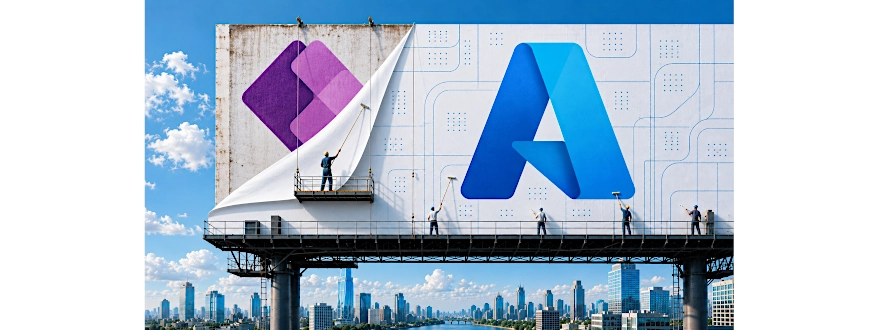
With AI-assisted development, many Canvas Apps can now be rebuilt as modern web applications in days or weeks instead of quarters. A migration that once required a large engineering initiative can now move surprisingly quickly when the workflow is structured correctly.
Much of that acceleration comes from reducing the repetitive structural work involved in rebuilding applications. Once the operational workflow is clearly understood, modern coding tools can scaffold interfaces, organize components, and establish baseline architecture surprisingly quickly. The more difficult work usually involves preserving the approvals, exceptions, dependencies, and business rules that evolved around the application over time.
Identify bottlenecks, automate workflows, and build fast.
Get Started TodayCanvas Apps still have an important place. They’re excellent for rapid experimentation and departmental tools. They also help teams move quickly without waiting for a traditional development cycle.
But complexity changes the economics. Once an application becomes operationally critical, then maintainability, governance, deployment workflows, and long-term flexibility start mattering far more than initial build speed.
As apps grow, leadership teams start asking new questions:
Those questions are becoming more urgent as organizations push toward stronger operational standardization, tighter cost control, and more mature AI governance.
Many teams are realizing that low-code platforms remain extremely effective for rapid delivery, but some applications eventually outgrow the operational model they were originally built within.
In many cases, the destination is a lightweight cloud-native web application running on platforms like Azure Static Web Apps. That operating model provides stronger source control, cleaner deployment workflows, and greater long-term flexibility than many organizations can achieve once a low-code application becomes operationally critical.
A Canvas App often looks highly specialized from the outside. But underneath, most are more portable than teams assume.
At a practical level, many Canvas Apps are combinations of:
That structure translates surprisingly well into modern web frameworks.
The UI itself is not the hardest part anymore. AI coding tools are increasingly good at generating forms, layouts, navigation patterns, and standard interactions.
The harder part is preserving business intent.
A dropdown rule might represent a compliance process. A visibility condition might reflect an operational approval path. A workaround inside the app may exist because a team adapted to platform limitations over time.
That’s why successful migrations are not simple “export and convert” exercises, but rather “business workflow modernization projects”.
This distinction is key because it changes how organizations should approach AI-assisted development. Rather than simply using AI to rebuild the application blindly, the goal is to leverage AI to accelerate the parts humans should not spend days rebuilding manually.
The most effective rebuild projects follow a disciplined pattern.
First, the Canvas App gets unpacked and analyzed. Teams identify screens, workflows, formulas, data dependencies, and operational edge cases.
Then the business logic gets separated from the platform-specific logic. This is where many projects either accelerate or stall.
Organizations that move quickly focus on understanding the workflow itself:
Once that structure is understood, AI-assisted development becomes extremely effective.
Modern coding assistants can rapidly scaffold React-based frontends, generate component structures, organize routing, and establish baseline data interactions. Instead of starting from a blank screen, teams start from a working draft.
That dramatically compresses development time.
The backend layer can then be rebuilt using lightweight cloud-native services such as Azure Functions and Azure Static Web Apps, creating a cleaner deployment pipeline with stronger source control and governance from the start.
This is where the operating model begins to shift. The application stops behaving like a specialized low-code asset and starts behaving like a standard modern software project with:
For many organizations, that long-term maintainability becomes more valuable than the hosting cost difference itself.
The speed of AI-assisted coding creates a new challenge: without governance, organizations can now generate technical debt faster than ever.
That’s why successful teams build review and operational discipline directly into the workflow.
AI-generated code still needs:
It’s not unlike modern manufacturing; automation speeds up production lines, and quality control determines whether the output is reliable enough to bring to market.
The same principle applies here.
The organizations getting the best results from AI-assisted development are not removing humans from the process. They are shifting humans toward higher-value review, architecture, and operational decision-making.
The larger story, at its core, is about modernization economics. Businesses are beginning to treat operational software less like a temporary toolset and more like long-term infrastructure.
For years, organizations delayed rebuilding aging operational systems because the replacement cost felt too high. AI-assisted development is changing that calculation.
A business application no longer needs to remain tied to its original platform simply because rebuilding feels unrealistic.
So that creates strategic flexibility. Organizations can start thinking differently about:
Not every Canvas App should be rebuilt. Many are perfectly suited to remain as and where they are. But business-critical operational systems deserve a different level of scrutiny than quick departmental tools.
Those decisions are becoming more important as AI accelerates the pace of software creation across the market.
The organizations seeing the strongest results are combining AI acceleration with disciplined workflows, strong governance, and clear operational ownership.
That’s the difference between simply “producing software quickly” and building systems a business can depend on long term.
If your team is starting to feel the strain between “quick-win” business apps and long-term operational maintainability, an outside architectural perspective can help clarify where modernization efforts will create the most value. Book a free consultation with Michael Weinberger to evaluate your current application landscape, identify operational bottlenecks, and pressure-test which systems are ready for a more scalable operating model.
Identify bottlenecks, automate workflows, and build fast.
Get Started Today
I’d love to help you with your tech needs. Just let me know how to reach you and when’s a good time to talk.
"*" indicates required fields