 +1 (248) 723-7903
+1 (248) 723-7903
+1 (248) 723-7903
Over the past year, many small and mid-sized businesses have moved from experimenting with AI to operationalizing it.
AI is now embedded in reporting, analysis, drafting, and workflow automation. Teams have invested time stabilizing outputs and building user confidence.
And even as those systems are settling into place, new models are emerging — promising stronger reasoning, deeper analysis, and improved reliability.
As a result, leadership faces a familiar tension:
Do we upgrade — and risk destabilizing what we just put in place?
Or do we hold steady — and risk falling behind?
This dilemma is understandable. AI models are evolving quickly. What felt cutting-edge six months ago may now be outperformed. The pace of change can make even thoughtful leaders feel like they are constantly one step behind the curve.
But this framing misses the deeper issue.
The important question is not whether the new model is better; but whether your system was designed to evolve.
In mature AI systems, models are interchangeable components — not structural foundations. The companies that win with AI will be the ones who design systems that absorb change without disruption.
If upgrading a model threatens your workflows, your reporting, or your team’s confidence, the vulnerability is in your architecture — not in the velocity of AI innovation.
Identify bottlenecks, automate workflows, and build fast.
Get Started TodayThe hesitation around upgrades is rarely about performance. It’s really about disruption.
Leaders worry that upgrading will destabilize workflows and erase the time and effort already invested in stabilizing them.
When a workflow depends tightly on the specific behavior of one model, any change introduces uncertainty. Even improvements can create disruption. Slight differences in reasoning patterns, output structure, or tool execution can ripple outward — affecting reports, automations, and user confidence.
When this happens, it’s not a failure of AI innovation – it’s simply a coupling issue.
To make this concrete, consider a simple analogy:
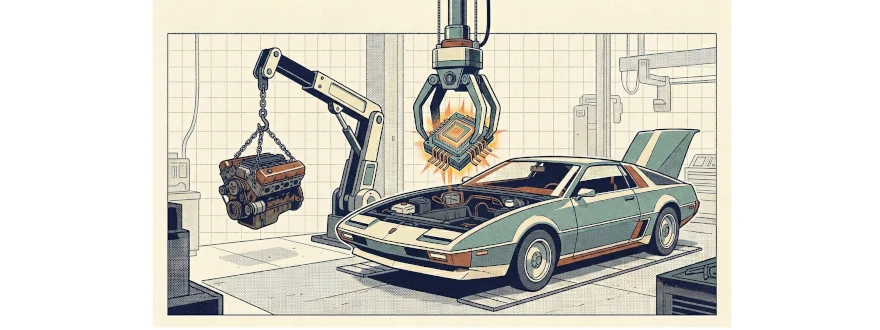
The AI model is the engine.
Your workflows, data pipelines, validation rules, and user interfaces are the vehicle.
In a well-designed vehicle, you can replace the engine without rebuilding the car. The steering system, the brakes, the frame — they remain intact. The upgrade improves performance without destabilizing the structure.
In mature AI systems, the model sits behind a boundary. Business logic, validation, and orchestration live outside it. When those layers are separated, upgrades become routine enhancements — not reconstruction projects.
That distinction matters.
Because when a model is treated as replaceable, upgrading becomes a performance decision rather than a structural gamble.
Sustainable AI systems are built for evolution. Model improvements enhance performance without disturbing the operational structure (workflows, data, and governance) around them. This is architectural maturity.
In a disciplined implementationWhen you join us as a new client, we take all the necessary ..., the AI model sits behind a clear boundary. The workflows that call it, the validation rules that check it, and the business logic that interprets it operate independently of the model itself.
That separation creates optionality. Teams can compare models without rewriting workflows, evaluate performance without operational disruption, and remain independent of any single vendor’s release cycle.
It also changes the economics of improvement. In tightly coupled systems, upgrades resemble reconstruction. In modular systems, they function as optimization.
The distinction is architectural intent. In mature AI environments, model upgrades are evaluated based on performance impact while the surrounding system remains stable.
At some point, every organization using AI will face the same moment:
A new model becomes available, promising better reasoning, stronger analytical performance, or improved reliability.
The question leadership asks in that moment reveals the maturity of the system.
In tightly coupled environments, the first question is operational: what will break?
In modular environments, the first question is evaluative: does this improve outcomes?
That distinction reshapes the upgrade decision.
When architecture is disciplined, upgrades are evaluated based on measurable performance impact. Teams can compare outputs, measure improvements, and make decisions based on impact — not fear. Existing workflows, prior investment, and stability remain intact.
The model evolves. The system holds. That is the standard that mature AI environments aim for.
Before the next upgrade, leadership can run a simple test:
If we switched models tomorrow, what would need to change?
If the answer includes core workflows, reporting structures, or validation rules, the architecture deserves attention.
If the only changes involve running existing workflows on the new model, reviewing the outputs side by side, and deciding whether the improvement justifies the switch, the system was designed correctly.
Over time, organizations that can evaluate and adopt model improvements without disruption compound their performance gains. Adaptability becomes part of how the business operates — not a periodic crisis to manage.
Identify bottlenecks, automate workflows, and build fast.
Get Started Today
I’d love to help you with your tech needs. Just let me know how to reach you and when’s a good time to talk.
"*" indicates required fields