 +1 (248) 723-7903
+1 (248) 723-7903
+1 (248) 723-7903
Across nearly every organization experimenting seriously with AI, a similar pattern is emerging.
Workers report that tasks move faster. Quality improves. People who once depended on specialists now complete work themselves – writing code snippets, analyzing spreadsheets, troubleshooting tools, drafting complex documents. In many environments, three out of four employees say AI improves either speed or quality, and an equal number say it allows them to do work they previously could not.
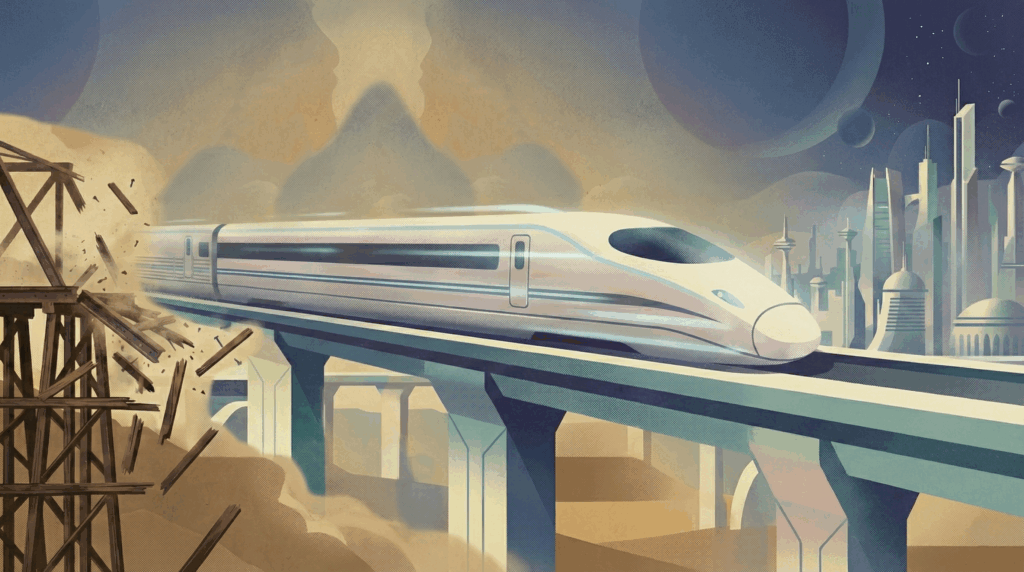
That combination of speed and expanded capability is more than a productivity story. It’s a signal that the structure of work itself is changing.
When who can do the work shifts, the way work is designed has to shift with it.
Even for organizations earlier in their AI journey, this shift begins sooner than expected. You don’t need full automation or custom systems for work design to matter. The moment AI drafts, summarizes, analyzes, or recommends – even in isolated pockets – it starts changing who can act, how quickly decisions happen, and where bottlenecks surface.
Identify bottlenecks, automate workflows, and build fast.
Get Started TodayMost small and mid-sized businesses have approached AI the same way they approached earlier waves of automation: by inserting new tools into existing workflows.
An intake step gets faster. A report is generated automatically. A document is summarized instead of read. Each improvement is real, measurable, and often impressive in isolation.
Yet taken together, these gains often sit atop processes that were never designed for this level of speed or flexibility. Approvals still bounce between inboxes. Exceptions still stall progress. Work still gets rechecked because no one is quite sure which outputs can be trusted.
The result is a strange tension: teams feel busier and faster at the same time, while leadership struggles to explain why overall throughput hasn’t changed as much as expected.
This tension emerges when faster execution collides with workflows that were designed around scarce skill and slow movement. When those constraints disappear, the old structure starts to creak. AI doesn’t create these limits – but it makes them impossible to ignore.
Consider a 75-person professional services firm that introduces AI tools to speed up client reporting. Analysts use AI to draft summaries, managers use it to generate insights, and leadership expects faster turnaround.
Individually, each step improves. Drafts appear sooner. Insights look sharper. But nothing else changes. Reports still wait days for review. Edits happen inconsistently. Final approvals bounce between inboxes because no one is sure which AI-generated sections require scrutiny and which do not.
The firm feels faster – yet delivery timelines barely move. The constraint was never drafting speed. It was how work moved, who owned decisions, and where trust was earned. AI simply exposed that mismatch.
One of the most underappreciated effects of AI adoption is how quickly skill boundaries blur.
Non-technical teams increasingly handle tasks that once required specialists. Analysts write light scripts. Operations staff debug automations. Managers generate first-pass analyses instead of waiting on reports. In internal communication data, coding-related messages from non-technical roles have risen sharply – a sign that capability is spreading outward.
Roles aren’t disappearing so much as shifting upstream, with the same people spending less time executing steps and more time shaping outcomes.
Expanded capability doesn’t remove the need for judgment, accountability, or oversight; it changes where those responsibilities create the most value.
This shift is rarely frictionless. People may hesitate to trust AI-generated work, worry about stepping outside traditional role boundaries, or revert to old review habits “just to be safe.” Without explicit guidance, teams compensate by adding informal checks and shadow approvals – recreating the very drag AI was meant to remove. Designing the structure of work is how organizations make new behaviors safe, legitimate, and repeatable.
As more people can safely execute technical steps, human contribution concentrates on design, review, and decision-making.
Organizations that fail to account for this shift often experience confusion rather than leverage. More people doing more work sounds like progress, until outputs vary widely and quality becomes uneven.
This is the point at which work design becomes the limiting factor.
As capability spreads, coordination matters more than execution.
In high-performing AI-enabled workflows, tasks are not simply “AI-powered.” They are intentionally placed. In practical terms, orchestration answers three questions:
Without these answers, AI speeds up execution while leaving responsibility ambiguous.
When orchestration is clear, the division of labor becomes visible. Machines handle throughput and consistency. Humans retain ownership of judgment, accountability, and risk. Clear handoffs exist between them.
Think of work as a sequence of stations rather than a blur of activity. Some stations specialize in speed and scale. Others specialize in judgment and risk management. The value comes from how those stations connect.
In this model, human effort is concentrated in a few critical places:
AI, in turn, handles the heavy lifting where consistency and speed matter most.
This division of labor will not emerge accidentally. It has to be designed.
As AI systems accelerate work, they also reduce friction – the pauses that once forced people to double-check, reflect, or intervene. Without intentional structure, this can produce large volumes of output with unclear ownership or validation.
Many teams experience this as a kind of organizational noise: drafts pile up, summaries circulate without context, decisions are made faster but revisited more often.
It’s ambiguity, not recklessness, that undermines quality at speed.
High-performing workflows embed deterministic checkpoints directly into the process:
These guardrails don’t actually slow work down. Rather – they prevent rework, loss of trust, and downstream correction. In practice, thoughtfully designed guardrails are what allow speed to compound safely instead of fragmenting the organization’s attention.
The financial impact of this structure is often understated. Clear checkpoints reduce rework. Defined ownership lowers review cycles. Explicit criteria cut decision reversals. In practice, teams see gains not just in speed, but in fewer handoffs, fewer exceptions escalated late, and less time spent “cleaning up” work after it should have been finished. The ROI shows up as reclaimed hours, reduced risk, and more predictable delivery – not just faster output.
Another pattern shows up consistently once workflows are well-designed: intensity matters.
The more frequently AI is applied to a specific, repeatable task, the greater the time savings become. Familiarity reduces friction. Edge cases get addressed. Outputs stabilize.
However, this only works when usage is standardized at the task level. When individuals each “use AI their own way,” learning doesn’t accumulate. Improvements remain personal rather than organizational.
Standardized orchestration – where the same task follows the same path every time – creates leverage:
This is the point at which AI stops feeling like an experiment and starts behaving like infrastructure.
For leaders trying to understand where they stand, a few focused questions are often more useful than a long checklist:
Manual routing is a signal that orchestration hasn’t fully formed.
Variation often indicates missing standards rather than creativity.
Implicit checkpoints rely on memory and goodwill. Explicit ones scale.
If not, the workflow is probably tool-bound rather than task-driven.
Early gains can be misleading if rework isn’t accounted for.
These question reveal whether AI has been layered onto existing habits or integrated into a redesigned system of work. They also don’t require technical expertise to answer.
The long-term advantage AI offers to SMBs isn’t speed alone, nor access to advanced tools. It’s the opportunity to redesign work around capability abundance rather than scarcity.
Organizations that recognize this shift early tend to move faster with less friction. They don’t chase every new feature. They focus on where intelligence belongs, where judgment is required, and how the two interact.
In that sense, AI rewards structural clarity more than technical sophistication. The companies that benefit most aren’t the ones with the flashiest demos, but the ones that take the time to align speed, skill, and accountability into a coherent system.
A practical place to start is to select one end-to-end process – intake to delivery – and map it explicitly. Identify which steps require human judgment, which can safely run at machine speed, and where approvals actually protect quality rather than delay it.
The goal is clarity, not simply automation for its own sake. It’s who decides, what gets trusted, and how work moves without stalling. Even a single redesigned workflow often reveals where AI is helping – and where structure is still missing.
The results of this exercise tend to be revealing – and often transformative.
If you’re an SMB leader unsure where to start – or even what questions to ask – a brief outside perspective can help. Book a free consultation with Michael Weinberger to get clarity on what starting points are likely to have the greatest impact for your organization.
#AIWorkflowDesign #FutureOfWork #WorkDesign #HumanInTheLoop #AIOperations
Identify bottlenecks, automate workflows, and build fast.
Get Started Today
I’d love to help you with your tech needs. Just let me know how to reach you and when’s a good time to talk.
"*" indicates required fields