 +1 (248) 723-7903
+1 (248) 723-7903
+1 (248) 723-7903
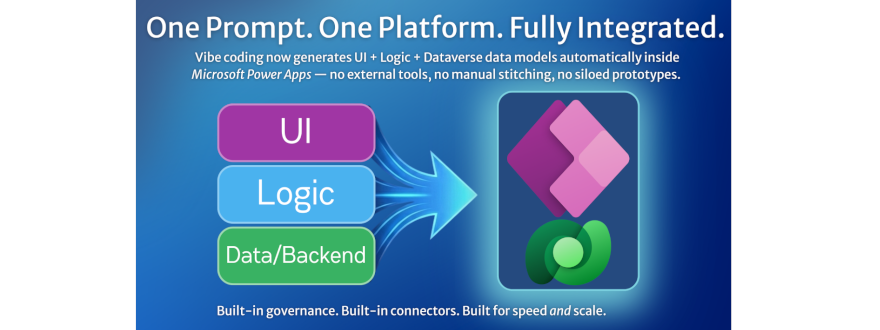
On November 18th, the doomsday clock for legacy low-code didn’t just tick forward – it shattered. With the unveiling of Vibe.PowerApps.com, Microsoft has fundamentally redefined our industry, moving us from the era of “pixel-pushing” into the age of Agentic Creation.
To be provocative but precise: the era of manually dragging controls onto a canvas or fiddling with low-code app builders is effectively dead. The future is well-architected Vibe Coding – and for the first time, the enterprise toolset has caught up to the “Fusion” vision we at Proactive have been championing for nearly six years.
Here is what this shift means for your business, and why PTM’s Digital Assembly Lineis the only framework ready to capitalize on it today.
Identify bottlenecks, automate workflows, and build fast.
Get Started TodayFor months, CTOs and business owners have looked at tools like Lovable.dev with envy – seeing the speed of “text-to-full-stack-app” generation but fearing the “Shadow IT” nightmare of ungoverned backends.
Microsoft just ended that trade-off.
The new Power Apps experience allows us to “code a full-stack application in minutes” using natural language, but with a critical difference: the backend is Microsoft Dataverse, not an isolated silo. This means we can now deploy true Code Apps (React, web standards) directly to the Power Platform from anydevelopment environment.
This is the “Fusion” dream realized: the flexibility of custom code, hosted on a managed platform, secured by Microsoft Entra ID, and enriched with governed access to over 1,400 connectors. It is the speed of a startup with the security of a bank.
The most profound announcement wasn’t just about building apps faster; it was about whouses them.
With the new Power Apps Model Context Protocol (MCP) Server, applications are no longer just screens for humans. They are now toolsets for Agents.
This is where PTM’s Digital Assembly Line methodology shines. We have always argued that a true System of Work orchestrates four types of workers: Humans, AI Agents, RPA Bots, and Procedural Logic. The new MCP Server validates this architecture perfectly. It allows autonomous agents to perform “intelligent form filling,” perform data exploration, and execute business processes inside your apps without human intervention.
Imagine an “Agent Feed” where your AI workforce collaborates with your human team, handing off tasks seamlessly. We aren’t just building user interfaces anymore; we are building Agent Interfaces.
For “Frontier Firms” looking to innovate, governance has often felt like a brake pedal. Microsoft has flipped this script by introducing an “Agentic Center of Excellence (CoE)”.
The platform now includes an improved advisor that acts as an always-on CoE, proactively guiding admins on security and architecture. Coupled with new inventory views and usage insights in the Power Platform Admin Center (PPAC), we can now visualize exactly which agents and apps are driving value – and which are creating debt – in real-time.
This aligns perfectly with PTM’s philosophy: Innovation needs guardrails, not gates. We can now deploy “Code Apps” and autonomous agents with the confidence that metrics are baked in from day one.
While many traditional low-code agencies are scrambling to hire React developers or understand how to govern “Code Apps,” the PTM Fusion Department is already native to this architecture.
For years, our “Fusion Stack” has been built precisely on this intersection of Pro-Code and Low-Code. We have deep production experience using Lovable.dev and TypeScript to build beautiful, consumer-grade frontends, while anchoring them to robust backends like Microsoft Dataverse and Azure SQL.
Previously, we had to architect complex bridges to host these “Lovable-style” applications on Azure Static Web Apps while syncing data back to your tenant. With the introduction of Vibe Power Apps, Microsoft hasn’t just validated our architecture – they’ve simplified it.
We can now take the exact same high-velocity, “vibe-coded” React applications we are famous for and deploy them directly into your Power Platform environment. We bring:
We aren’t learning this platform today. We’ve been waiting for it.
The danger of “Vibe Coding” is that it makes building anythingincredibly fast. Without a compass, this doesn’t create value; it creates legacy debt at record speeds.
Just because you can build an app in 5 minutes doesn’t mean you should.
This is why our AI Jumpstart Digital Assembly Line Discovery is the most critical first step you can take in this new era. Before we write a single line of code or generate a single Vibe app, we engage in a rigorous discovery process to map your business as a Digital Assembly Line.
By identifying high-value bottlenecks first, we ensure that these powerful new tools are pointed at your most expensive problems. We help you prioritize:
The AI Jumpstart ensures that when we turn on the “Vibe” engine, it drives measurable ROI, not just digital clutter. In a world where app creation is free, problem selection is the new premium.
This revolution isn’t just a software update; it’s a paradigm shift that requires a new kind of architectural partner.
The tools have finally caught up to the vision. With Microsoft unifying chat experiences with app development in the Power Platform, the window to modernize your “System of Work” is opening wide.
Don’t just “vibe” with the new tools – architect with them by partnering with the Proactive Technology Fusion Development team to realize the full potential of your business, rebuilt for AI.
Ready to become a Frontier Firm? Partner with Proactive Technology Management. We turn this technological revolution into your competitive advantage.
#PowerPlatform #VibeCoding #MicrosoftIgnite #FusionDevelopment #ProactiveTechnology #DigitalAssemblyLine #Dataverse #AgenticAI
Identify bottlenecks, automate workflows, and build fast.
Get Started Today
I’d love to help you with your tech needs. Just let me know how to reach you and when’s a good time to talk.
"*" indicates required fields